
If you need to use an official document in another country, an apostille is likely part of the process. Many people search for this information only after running into problems, so this guide explains what qualifies, what commonly causes rejections and what to check before submitting anything.
What Is an Apostille and Why Does It Matter?
An apostille is a certification that verifies the authenticity of an official document for use in a foreign country. It does not change the document itself. It confirms that the signature, seal, or stamp on the document is legitimate and was issued by the correct authority.
Apostilles are recognized by countries that are members of the Hague Convention, which currently includes over 120 nations. If the destination country is not a member, a different process called embassy legalization is required instead. Confirming which process applies to the destination country before submitting anything is the most important first step.
Which Documents Can Be Apostilled?
Apostilles are attached to public records, certified copies and properly notarized documents intended for use in a Hague Convention country. The document must be traceable to the correct official source.
| Document Type | Common Examples | What to Confirm |
| Vital records | Birth, death and marriage certificates | Must be a certified copy, not a plain photocopy |
| Court records | Divorce decrees, judgments, probate papers | Typically must come from the court clerk |
| School records | Diplomas, transcripts, enrollment letters | May require certification from the school first |
| Business documents | Certificates of status, corporate filings, agreements | Some require state certification before apostille |
| Notarized documents | Affidavits, authorizations, power of attorney | Must carry proper notarization |
| Background checks | FDLE or law enforcement records | Source must match what the foreign agency requested |
Why Do Documents Get Rejected?
Most apostille rejections do not happen because of the apostille process itself. They happen because the wrong version of the document was submitted.
Common reasons include:
- Submitting a photocopy when a certified copy is required
- Using a document issued in another state for a Florida apostille request
- Missing or incomplete notary certificate wording
- An expired, unclear, or unauthorized signature
- Sending a federal document to the Florida Secretary of State instead of the correct federal office
- Requesting an apostille when the destination country requires embassy legalization
A document can appear completely official and still be rejected if it does not meet the specific requirements of the receiving office. Timing matters as well, since some receiving agencies will not accept a document if too much time has passed since it was issued, so it is worth confirming how long an apostille remains valid before submitting paperwork that has been sitting for a while.
Easy Notary Solutions for Every Need
Personal Records: Birth Certificates, Marriage Certificates and More
Personal records are among the most common documents submitted for apostille. Birth certificates, marriage certificates, death certificates, divorce records, adoption papers and single status affidavits are frequently needed for immigration, marriage abroad, school enrollment, inheritance matters and other official purposes overseas.
The source of the document is what matters most. A Florida birth certificate must be a certified copy obtained from the appropriate state records office. A scanned printout or handwritten copy is not accepted.
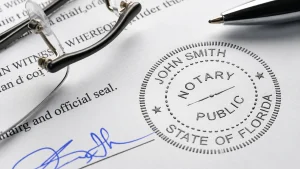
One point that causes frequent confusion is the difference between notarization and apostille. A notary public verifies the identity of the person signing a document. An apostille confirms the legitimacy of the official signature or seal already on the document for international recognition. In some cases, both steps are required before a document is ready for submission.
Business Documents: What Qualifies and What Needs Preparation
Business owners often need apostilles for contracts, certificates of status, articles of organization, board resolutions, commercial letters, power of attorney documents and vendor agreements.
Some business records are issued directly by the state and can move to the apostille stage without additional steps. Others, such as a signed company authorization letter or an internal agreement, are private documents that require notarization before they can be apostilled. The document type determines the path.
Business documents are easy to mishandle because there is no single rule that applies to all of them. A state-issued certificate of good standing is treated differently from a company letter, even if both are going to the same destination country. Businesses with tight timelines often ask whether apostille requests can be submitted online rather than in person and in Florida that option is available.
School and Identification Documents
Academic documents can generally be apostilled, but they are rarely ready in the form a person has at home. A diploma or transcript typically needs to come directly from the school, registrar, or official records office before it qualifies for the next step. In some cases, the institution must certify the record first, or a notarized statement may be required before the apostille request can be submitted.
Identification documents work differently. A copy of a passport or driver’s license is not apostilled as a plain photocopy. Depending on the document and the country where it will be used, the copy may need a notarized true copy statement attached to it. That detail is easy to overlook and often causes delays.
Background Checks and Law Enforcement Records
Background check documents issued by FDLE or local law enforcement in Florida can be apostilled, but the source must match exactly what the foreign agency, employer, or immigration authority requested. Submitting the wrong level of report or a document from the wrong issuing office will result in rejection.
If a background check is part of an apostille request for immigration, employment abroad, or international licensing, confirming with the receiving party exactly which type of report they require before ordering it is important. A Florida background check that includes FDLE processing is the most commonly accepted format, but requirements vary by country and purpose.
What Gets Reviewed Before an Apostille Is Submitted
Rushing the submission is one of the most common reasons apostille requests fail. Reviewing the document thoroughly before it goes out is what determines whether the process moves forward or starts over.
People often assume an apostille is just a stamp, but the certificate itself includes specific fields covering the document’s origin, the issuing authority and the certifying seal. If any of those elements are missing or mismatched, the document will not be accepted.
Before submitting, a specialist will typically confirm:
- Whether the document is a Florida record, a federal record, or from another state
- Whether the document is an original, a certified copy, or a notarized copy
- Whether the destination country accepts apostilles or requires embassy legalization
- Whether the notary wording is complete and correctly formatted
- Whether the document needs additional preparation before it qualifies
Getting It Right the First Time
Not every official-looking document is ready for apostille. Some need certified copies. Some need notarization first. Some need to go to a federal office rather than the Florida Secretary of State. Knowing which path applies to the specific document and destination is what prevents delays.
For Florida residents, families and business owners working through this process, Notary Plus More provides apostille services that include a document review before submission, so the paperwork is correct before it leaves your hands.