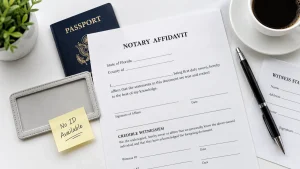

An affidavit is a written statement of facts that the signer, known as the affiant, swears or affirms to be true before a notary. There is no single fixed number of affidavit types. Courts, lenders, government agencies and private institutions each rely on forms built for a specific purpose, so the practical answer to how many types of affidavit exist depends on the matter at hand rather than on any closed legal list. What unites them is the standard of execution.
The right facts, the correct sworn wording, verified identity and a properly completed notarial certificate all have to align, because an otherwise accurate document can still be rejected when one of those elements is missing.
What Is an Affidavit and How Is It Legally Used?
An affidavit is sworn testimony in written form. It commonly supports a court filing, verifies identity, sets out financial circumstances, or confirms that a required step was completed. Because the statement is made under oath, a false affidavit can carry the same consequences as false testimony given in open court, which is what gives the document its weight.
That weight is also why proper execution matters as much as the wording. During affidavit notarization, the notary administers the oath or affirmation and records, through a jurat, that the affiant swore to the contents and signed in the notary’s presence. The facts remain the affiant’s own. The certificate simply confirms that the swearing took place correctly.
How Many Types of Affidavit Are There in Practice?
No statute caps the number. The different types of affidavit are generally named after the fact they establish or the process they support, and new variations appear whenever an institution needs a particular fact placed on the record. The categories below are the ones that arise most frequently in legal and administrative work.
| Affidavit type | Common use |
| Financial | Income, debts, assets, or support obligations |
| Service | Proof that legal papers were delivered |
| Diligent search | Documented efforts to locate a person |
| Residency | Confirmation of a current address |
| Domicile | Legal home, often in estate matters |
| Heirship | Family relationship to a deceased person |
| Identity | Name or record discrepancies |
| Support | Financial sponsorship in immigration cases |
The governing form still controls the outcome. Even a well-drafted statement can fail when the receiving court or agency requires its own template, so confirming the correct version before the appointment prevents a return visit.
Which Affidavits Appear in Court Proceedings?
Several affidavit types are tied directly to litigation, and each carries its own evidentiary expectations. Financial affidavits are common in family law, where they disclose income, expenses, property, and debts. An omitted account or an inaccurate figure can distort support calculations and stall the disclosure process.
Affidavits of service establish when, where, and to whom legal papers were delivered. When these details are vague, opposing parties can dispute whether proper notice was ever given.
Diligent search affidavits record the steps taken to locate a person who cannot be found. Florida courts prescribe specific forms for certain family matters, so a general narrative of the search efforts may not satisfy the rule. In each case, the affidavit has to match the case type, the applicable filing rule, and the deadline.
Types of Affidavits That Establish Personal Details
A second group of affidavits exists to confirm facts about a particular individual. Residency affidavits verify where a person currently lives and frequently appear in school admissions, licensing applications, and benefit claims. Domicile affidavits address a person’s permanent legal home, a distinction that becomes significant in probate and asset transfers. The two terms sound interchangeable but are not, and the requirements for a residency affidavit can change depending on whether it is bound for a school, a court, or a government office.
Other personal affidavits include name change affidavits, one-and-the-same-person affidavits, marriage and relationship affidavits, lost document affidavits, identity affidavits, and statements that explain a correction in the record. Each one must stay within the affiant’s direct knowledge. An affidavit is not the place for assumptions, second-hand accounts, or facts the signer cannot personally confirm.
Choose Right Notary Solution for Your Needs
How Affidavits Affect Property and Estate Documentation
Property and estate transfers rely on affidavits to settle facts that recorded documents do not make clear. An affidavit of heirship can identify the relatives entitled to an interest when ownership comes into question after a death. A small estate affidavit may support a streamlined transfer where state law permits one. An affidavit of domicile can establish where the deceased legally resided.
Real estate files often include affidavits of title, ownership, or no liens, and these typically need to be in order before a transaction can close or record. Because property law, probate rules, and recording standards differ from state to state, the form has to suit the jurisdiction. A notary can perform the requested notarial act, but the notary does not select the legal form on the signer’s behalf.
Legal Staff Responsibilities Before the Signing Process
A smooth signing depends on preparation completed before the appointment. Legal staff should verify the case caption, full legal names that match the signer’s identification, facts stated clearly in numbered paragraphs, any required exhibits, and any blank spaces that still need to be completed. The correct certificate also has to be in place, since an affidavit calls for a jurat rather than an ordinary acknowledgment.
The affiant must fully understand the statement before signing. Under Florida law, the notary verifies identity using personal knowledge or valid government-issued photo ID and witnesses the oath and signature in person. While staff may explain the document, the content must remain the affiant’s own statement.
Impact of Using an Incorrect Affidavit or Certificate
The consequences are practical and costly. A defective affidavit can lead to a rejected filing, a delayed hearing, or a second signing appointment. In a property matter, recording may halt entirely. In family court, unresolved service or support questions can hold up the case.
Cross-border use adds another layer. A notarized statement intended for a foreign authority usually requires further document authentication services before it will be accepted abroad. For countries party to the Hague Convention, a properly executed Florida affidavit can be certified through apostille services in Florida by the state authority. For destinations outside that framework, the document may need additional international document legalization through the relevant consulate. Confirming the destination country’s requirements early keeps academic, immigration, and financial paperwork on schedule.
The Bottom Line
Selecting the right affidavit and executing it correctly are two separate responsibilities, and the distinction protects everyone involved. The legal professional controls the wording, the substance, and the choice of form. The notary verifies identity, administers the oath or affirmation, and completes the notarial certificate.
Notary Plus More supports legal teams by confirming that a document is complete and properly prepared before the notarial act begins. Its Florida notary services cover identity verification, the oath or affirmation, and the jurat that gives a sworn statement its standing. The right affidavit proves the right fact, and proper execution gives it a fair chance of acceptance the first time it is filed.