
Notarization can be delayed by a single missing detail: a signer who does not present acceptable identification. This issue commonly arises during property transactions, affidavits, business agreements, and family documents. Even when all paperwork is complete, a notary cannot proceed until the signer’s identity is properly verified.
Florida law establishes clear standards for confirming identity. A quick glance at a card is insufficient. The notary must match the individual appearing whether in person or via video to the name on the document and must record the method of verification. For remote notarizations, online ID requirements illustrate why this process involves more than simply showing an identification card to a webcam.
Confirming Identity Through Knowledge and Documents
Under Florida law, a notary may establish identity through one of two methods: personal knowledge or satisfactory evidence. Personal knowledge requires an established, ongoing acquaintance between the notary and the signer, sufficient to identify that individual with reasonable certainty. Recognizing someone from a local business, a neighborhood, or a social media profile does not satisfy this standard.
What the Notary Reviews
When verifying identification, the notary assesses the complete context. The name and photograph must match the signer, and the document should appear unaltered. The notary also looks for inconsistencies, such as a mismatch between the photograph and the person presenting the ID, or uncertainty about the name being signed.
The signer must personally appear. For in-person notarizations, this requires physical presence, while remote online notarizations occur via approved audio-video technology. A simple phone call from someone claiming to be the signer does not satisfy Florida’s appearance requirement.
Acceptable Forms of Identification Under Florida Law
Florida Statute 117.05 outlines the forms of identification a notary may accept. The ID must be current or issued within the last five years and include a serial or other identifying number. This standard ensures notarizations are both valid and accurate, going beyond simply presenting a “photo ID.”
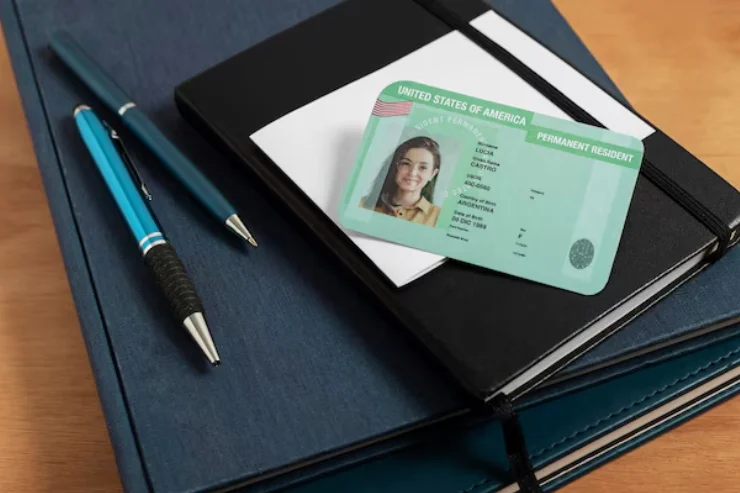
Acceptable documents include a Florida driver’s license or state ID card, a United States passport, an ID issued by another state, territory, Canada, or Mexico, a U.S. military or veteran health ID card, a USCIS identification card, and a foreign passport with the required USCIS stamp. An expired ID is not automatically disqualified for an in-person appointment; eligibility depends on the issue date and document type, a distinction further explained in the expired ID guide. Remote online notarization requires separate credential analysis and identity verification, so identification should always be confirmed with the notary prior to the session.
Choose Right Notary Solution for Your Needs
Witness-Based ID Verification
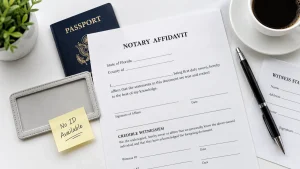
In rare cases, a notary may verify a signer’s identity using a credible witness. This option is strictly limited and is not intended as a general replacement for proper identification.
Requirements for a Credible Witness Statement
Florida allows either one credible witness who personally knows both the signer and the notary, or two credible witnesses whose identities are independently verified by the notary. The sworn statement must confirm that each witness personally knows the signer, that the signer is the individual named in the document, that obtaining another acceptable form of identification is difficult or impossible, that the signer does not possess a listed identification document, and that the witness has no financial interest in the transaction. These rules are intentionally strict; recent acquaintances or relatives who benefit from the transaction generally do not qualify.
Verifying Identity for Remote Online Notarization
Remote notarizations services have additional verification requirements. Unless the notary already has personal knowledge of the signer, Florida requires presentation of a government-issued credential, credential analysis, and identity proofing such as knowledge-based authentication. The notary and signer remain connected via recorded two-way audio-video communication throughout the appointment. A blurred camera image, damaged identification, or failed verification questions may prevent completion of the session.
Preparing for a Signing Appointment
A short review before the appointment helps avoid delays. Signers should bring an original, acceptable ID, the full set of documents with any required signature lines unsigned, any necessary witnesses, supporting name-change records if names differ, and a reliable camera and internet connection for remote sessions. The notary verifies the signer’s identity, a process separate from Florida background checks, which serve a different function.
Final Thoughts
Insufficient identification can result in a refused appointment, delayed filing, or uncertainty about whether the correct individual signed the document. A diligent notary will decline to proceed when identity cannot be confirmed, reflecting professional responsibility rather than a service failure. For businesses, a failed signing can delay a lease, vendor authorization, banking form, or corporate filing. The disruption usually originates from uncertainty in verification, not the notarial act itself.
Notary Plus More incorporates thorough identity verification into all in-person and remote appointments, documenting the method clearly on the notarial certificate. Confirming identification prior to the appointment takes only a few minutes and prevents rescheduling once all parties are present, making the process far more efficient.