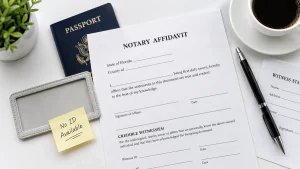


When an employer hires someone who works remotely or lives far from the company’s offices, the new employee is often told to find a notary to complete Form I-9. A notary public may complete the employer’s portion of the form only when acting as the employer’s authorized representative and not as a notary. Form I-9 contains no notarial certificate, so the notary does not apply a seal, record the transaction as a notarial act or charge a notarial fee for it.
The distinction matters because both employers and employees regularly assume the form needs to be “notarized.” In practice, U.S. Citizenship and Immigration Services (USCIS) allows an employer to designate any person to complete Section 2 on its behalf. A notary is simply one convenient choice for that role.
Form I-9 Requirements for Employment Eligibility Verification
Form I-9, Employment Eligibility Verification, confirms the identity and work authorization of every person hired for employment in the United States. The employee completes Section 1 no later than the first day of work for pay. The employer then completes Section 2 within three business days of that start date, after examining original documents that establish identity and employment authorization.
The documents must generally be examined in the employee’s physical presence, so the reviewer can confirm that they appear genuine and relate to the person presenting them. A passport alone may satisfy both requirements, while other combinations pair an identity document, such as a driver’s license, with a work authorization document, such as a Social Security card.
Responsibilities of an Authorized Representative in Form I-9 Verification
USCIS permits an employer to designate, hire or contract with an individual to complete Section 2 or Section 3 on its behalf. That individual is known as an authorized representative. The representative can be a notary, a human resources contractor, a manager at another location or even a trusted acquaintance of the employee, provided the employer has chosen that person.
Whoever acts in this role takes on the same tasks the employer would perform. The representative examines the original documents in person, records the document details in Section 2, signs the attestation and enters the date. In the title field, the representative indicates that the form was completed as an authorized representative rather than listing a notarial title.
Responsibility does not transfer with the task. The employer remains liable for any errors or violations in the form, including mistakes made by the authorized representative, which is why many employers provide written instructions with the form.
Why Form I-9 Verification Is Not Considered a Notarial Act
A notarization requires a notarial act, such as an acknowledgment or a jurat, supported by certificate wording. Form I-9 contains no such wording. The representative signs an attestation about the documents reviewed, which is a different type of statement from the one a notary makes on a notarial certificate.
For that reason, the National Notary Association advises that a notary acting as an authorized representative should not affix a seal and should not enter the transaction in the notarial journal. Applying a seal could mislead the employer or a government auditor into believing a notarial act was performed. Notaries who agree to serve often keep a separate business record of the employee’s name, the requesting employer and the date.
This boundary reflects the broader limits on notarial authority under chapter 117 of florida statutes, which defines what a Florida notary may and may not certify. Reviewing employment documents falls outside those notarial acts, even when a commissioned notary performs the review.
Choose Right Notary Solution for Your Needs
Documents Employees Need for Form I-9 Verification
Preparation reduces the risk of a second appointment. The employee should bring the employer’s instructions, a copy of Form I-9 with Section 1 already completed and original, unexpired documents from the Lists of Acceptable Documents. Photocopies are not acceptable for the examination. A document that appears altered or expired should not be accepted.
Name consistency also deserves attention. When the name on a driver’s license differs from the name on a Social Security card because of marriage or another change, the employer may ask for additional explanation. Employees who need a separate sworn statement for a different purpose, such as a name affidavit, should arrange that as its own notarial act, distinct from the Form I-9 review.
Form I-9 Verification Options for Remote Employees
Since August 1, 2023, the Department of Homeland Security has offered an alternative procedure that allows qualifying employers enrolled in E-Verify and in good standing to examine documents remotely through a live video interaction. Employers that do not use E-Verify or that choose not to adopt the alternative procedure still need someone to examine documents in person.
For those employers, an authorized representative near the employee remains the practical option. A mobile notary appointment can bring the representative to the employee’s home or workplace, which is helpful when the start date is close and the three-business-day deadline is approaching.
Common Form I-9 Verification Mistakes and Ways to Avoid Them
Several errors appear frequently when Form I-9 is completed by someone outside the company:
- Applying a notary seal or notarial certificate to the form
- Accepting photocopies or digital images instead of original documents
- Completing Section 2 before the employee has completed Section 1
- Recording incorrect document numbers or expiration dates
- Missing the deadline of three business days after the start date
Employers can reduce these risks by sending clear written instructions, confirming that the representative understands the role and reviewing the completed form promptly. Form I-9 is only one part of onboarding. Many employers also confirm prior positions through employment history checks as part of their wider screening process.
Employment and Onboarding Documents That May Require Notarization
Some onboarding documents do require a genuine notarial act, such as sworn statements, affidavits, powers of attorney or certain licensing applications. In those cases, a Florida notary public identifies the signer and completes the appropriate notarial certificate. Keeping these tasks separate from the Form I-9 review helps employers maintain accurate records for each purpose.
Final Thoughts
Notary Plus More supports Florida employees and employers with in-office, mobile and remote online notarizations for onboarding and licensing documents. Employers considering a notary as an authorized representative for Form I-9 can discuss the request and their written instructions with the team before the appointment, so the employee arrives prepared and the form is completed within the required timeframe.