
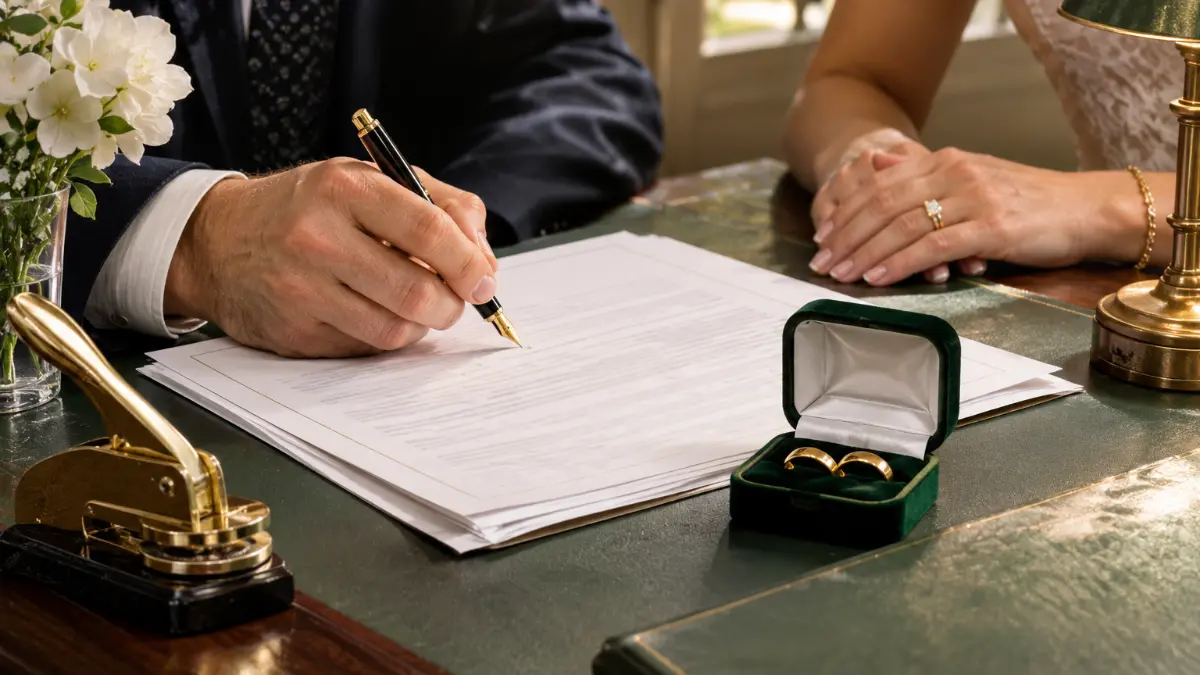
Couples finalizing a premarital agreement often reach the signing stage with one practical question: does a prenup need to be notarized to be valid in Florida? Florida law does not require it. Under section 61.079 of the Florida Statutes, a premarital agreement must be in writing and signed by both parties. It becomes effective upon marriage. Notarization still plays a valuable role, however. Certain provisions in a prenup also carry witnessing requirements of their own.
Many family law attorneys still have the prenup notarized as standard practice. The reasons relate to proof, enforcement and how the agreement may be used years after the wedding. Couples who understand these distinctions can plan a signing that satisfies every applicable statute rather than only the minimum.
Florida Prenuptial Agreement Requirements
Florida adopted the Uniform Premarital Agreement Act, codified in section 61.079. The formal requirements are short. The agreement must be written, it must be signed by both parties and it requires no consideration other than the marriage itself.
Once the couple marries, the agreement can be amended or revoked only by a later written agreement signed by both spouses. An oral promise to change the terms has no legal effect. Neither the original agreement nor an amendment needs to be notarized under section 61.079.
Where Witnesses Become Necessary
Many prenups do more than divide property in the event of divorce. They often include a waiver of rights that a surviving spouse would otherwise hold at death, such as the elective share, homestead rights, an intestate share, exempt property and the family allowance. These provisions fall under a different statute.
Section 732.702 requires a waiver of spousal rights to be signed by the waiving party in the presence of two subscribing witnesses. A prenup that contains this waiver but lacks proper witnessing risks having that section disregarded when an estate is administered. Understanding the difference between a notary and a witness matters here, because a notary’s acknowledgment does not replace the two witness signatures the statute requires.
The statute also addresses financial disclosure. A waiver signed before marriage requires no disclosure under section 732.702. A waiver signed after marriage, by contrast, requires each spouse to make a fair disclosure of their estate. Questions about who can witness a legal document are best settled before the signing appointment, since witnesses should be adults with no interest in the agreement.
Choose Right Notary Solution for Your Needs
Why Couples Still Use a Prenup Notary
A prenup may not be enforced or challenged until decades after it is signed. By that time, memories fade and one spouse may claim that the signature on the document is not theirs. A notarized prenup carries a notarial certificate confirming that each signer appeared, was identified and acknowledged signing the agreement.
That identification step is formal. A Florida notary confirms each signer’s identity using acceptable forms of identification, such as a current driver license or passport. The notary also records the transaction in a notarial journal. This record provides independent evidence of who signed and when.
Notarization also matters when the agreement is used for other purposes. A prenup that will be relied on in another country may require an apostille. Florida issues an apostille for a private agreement only after it has been notarized. Instruments recorded in county public records, such as deeds that carry out property terms in the agreement, must also be acknowledged before a notary. Couples can arrange this through florida notary services once their attorneys have finalized the text.
What Notarization Does Not Do
A notary verifies identity and willingness to sign. The notary does not review the terms, confirm that financial disclosure took place or assess whether the agreement is fair. Florida notaries who are not attorneys also cannot draft the agreement or advise either party on its contents.
Under section 61.079, a court may decline to enforce a prenup if a spouse proves it was not signed voluntarily or was the product of fraud, duress, coercion or overreaching. A court may also refuse enforcement if the agreement was unconscionable when signed and the challenging spouse lacked fair and reasonable disclosure of the other’s finances. Notarization does not prevent these challenges. Independent legal counsel for each party and complete financial disclosure remain the strongest protections.
Signing Arrangements for Both Parties
Both parties do not have to sign at the same moment, although many couples prefer a single appointment with both attorneys present. When schedules conflict, each person can sign separately before a notary, with witnesses present for any spousal rights waiver.
Location can also be arranged around the couple. A mobile notary appointment brings the notary to a home, office or law firm conference room. When one partner lives in another state or overseas, Florida’s remote online notarization law permits signing through a secure audio-video session. Witnesses may also take part remotely, subject to statutory conditions.
Timing the Signing Before the Wedding
Florida law sets no minimum period between signing a prenup and the wedding date. Timing can still become relevant if the agreement is later challenged, because an agreement presented days before a ceremony may support a claim of duress or coercion. Family law attorneys commonly recommend signing well in advance so that each party has time to review the terms with counsel.
Couples should also keep the signed original in a secure place and provide each attorney with a copy. Storing a scanned version separately protects against loss, although the original remains the document a court will expect to see if enforcement is ever sought. Where the agreement waives estate rights, a copy kept with each spouse’s estate planning documents helps personal representatives locate it when needed.
Final Thoughts
Notary Plus More notarizes premarital agreements for couples across Palm Beach and Broward counties at its Boca Raton office, through mobile appointments and by remote online notarization. The team can coordinate the appointment around both parties and their attorneys, although it does not draft agreements or provide legal advice on their terms. Couples can book an appointment once their agreement is finalized to complete the signing well before the wedding date.