

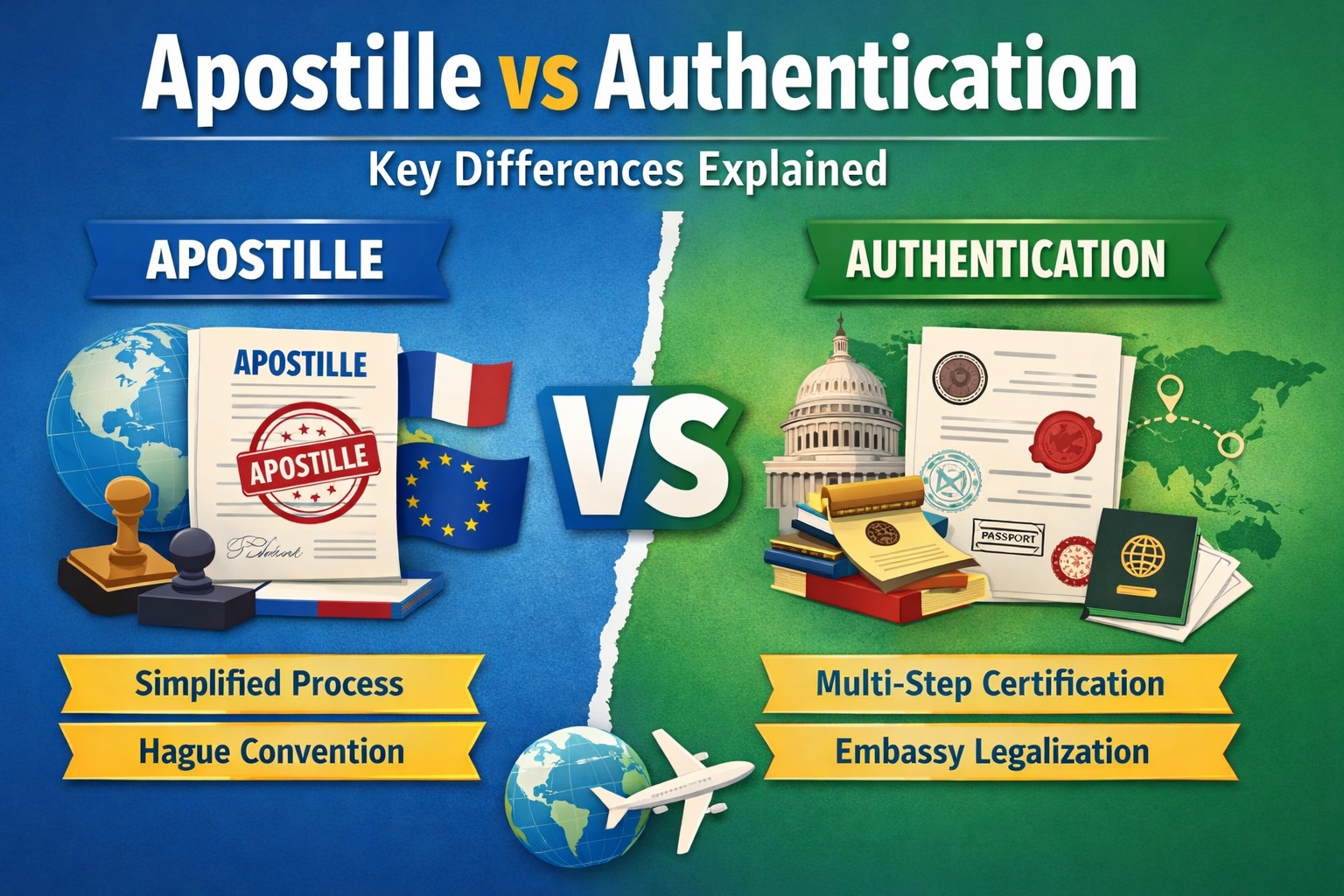
You’re planning to work overseas. Maybe adopting a child from another country. Or expanding your business internationally.
Then someone at the embassy says: “You need an apostille.” But the attorney mentioned “authentication.” Your document processing service talks about “legalization.”
Same thing? Different things? Here’s what actually matters.
What Is an Apostille?
An apostille is a certificate that validates your document for international use. It’s basically an official stamp saying “this document is genuine and legally recognized.”
The name comes from the 1961 Hague Apostille Convention. Over 120 countries signed this treaty agreeing to accept a standardized certificate. One stamp, recognized everywhere in the convention.
The Legal Framework
The Hague Convention created a streamlined system. Before 1961, international document recognition required multiple government offices and embassies. The apostille changed that with one standardized certificate member countries accept automatically.
Documents That Commonly Need Apostilles
| Document Type | Typical Use |
| Birth/Marriage Certificates | Visa applications, citizenship claims |
| Diplomas & Transcripts | International employment, education |
| FBI Background Checks | Immigration, work permits |
| Power of Attorney | Overseas property, legal representation |
| Corporate Documents | Business expansion, contracts |
According to recent data, demand for apostille FBI background checks has surged nearly 40% since 2023 due to increased immigration and international employment opportunities.
How Notarization Connects
Before you can get an apostille on certain documents, they need notarization. Understanding the difference between apostille vs notary public helps clarify the process.
A notary verifies signatures and confirms identities. Then the Secretary of State apostilles the notary’s signature. Two-step process: notary confirms the signer, state confirms the notary.
What Is Authentication?
Authentication is what you need when the destination country didn’t join the Hague Convention. It’s more involved than apostille.
The Multi-Step Process
Here’s what authentication actually looks like:
Step 1: Notarization The document gets notarized (if it’s a private document like a contract or affidavit).
Step 2: State Certification Your Secretary of State certifies the notary’s signature.
Step 3: Federal Authentication The U.S. Department of State authenticates the state certification.
Step 4: Embassy Legalization The destination country’s embassy or consulate in the U.S. legalizes everything.
That final embassy step is what separates authentication from apostille. It’s also called “consular legalization.”
Countries Requiring Authentication
Not every country joined the Hague Convention. Major examples include China (joined in 2024 but still transitioning), UAE, Vietnam, Saudi Arabia and Canada (joined 2024).
Each has specific requirements. Some want certified translations, others need particular forms. The UAE requires different procedures than Vietnam.
Processing Timeline Reality
Authentication takes longer because of that embassy step. Here’s what to expect:
- State certification: 1-2 weeks
- Department of State: 3-6 weeks (can be longer)
- Embassy legalization: 2-8 weeks depending on the country
Total timeline? Often 6-12 weeks. Sometimes longer if paperwork gets rejected for minor errors.
Key Differences in a Snapshot
| Factor | Apostille | Authentication |
| Countries | 120+ Hague members | Non-Hague members |
| Process Steps | 1-2 (notary + apostille) | 4 (notary + state + federal + embassy) |
| Average Timeline | 2-4 weeks | 6-12 weeks |
| Typical Cost | $15-50 per document | $100-300+ per document |
| Embassy Visit | Not required | Required for legalization |
| Validity | Indefinite in most cases | Varies by country |
One important note: apostilles don’t expire in most situations, but some countries impose their own time limits on how “fresh” documents need to be.
How to Know Which Process You Need
The destination country decides everything. Period.
Step 1: Check the Hague List
The U.S. Department of State maintains the official list of Hague Convention members. If your country is there, you need an apostille. If not, you need authentication.
Step 2: Verify Document Origin
Where the document was issued matters:
- State documents (birth certificates, marriage licenses) → State Secretary of State
- Federal documents (FBI checks, Social Security letters) → U.S. Department of State
- Private documents (contracts, affidavits) → Notarize first, then proceed
Step 3: Watch for Special Cases
Canada joined the Hague Convention in January 2024, creating temporary confusion as some authorities still request the old process during system transitions.
Common rejection causes: using apostille for non-Hague country, submitting to wrong authority, missing notarization, expired notary commission, incomplete signatures or wrong copy type. Any of these means starting over with new fees and wait times.
What Notaries Do in This Process
Notaries don’t issue apostilles or handle authentication. But they start the chain.
The notary confirms your identity with government ID, witnesses your signature and applies their seal. This creates the “official act” that state authorities later certify. Experienced notaries catch errors before you waste weeks in the pipeline.
Working with professional notary services helps avoid rejections.
Processing Tips
- Start early: Plan for 6-8 weeks minimum
- Original documents only: Photocopies don’t work
- Verify everything: Missing seal or signature causes rejection
- Track your documents: Use trackable shipping
- Keep copies: Scan before sending
Recent federal statistics show processing times at the U.S. Department of State have increased by 35% since 2020, averaging 6-8 weeks currently.
The Real Impact of Getting It Wrong
Submit an apostille when you needed authentication? The receiving country rejects it.
Send documents to the wrong Secretary of State? They mail everything back unprocessed.
Each mistake adds 4-8 weeks to your timeline. For visa applications or time-sensitive business deals, that delay has real consequences.
Understanding the Current Landscape
The apostille system is evolving. Singapore launched digital e-Apostille services in 2025. France updated rules in January. Bangladesh joined in March.
Document authentication demand keeps increasing with more international mobility. Getting the apostille vs authentication decision right saves weeks of delays and hundreds in fees.
If you’re navigating international document requirements, experiencednotary and apostille services can help avoid costly mistakes.