
Your court filing gets rejected. The reason? Wrong notarial certificate. You used an acknowledgment when the affidavit required a jurat.
This happens more than you’d think. According to the National Notary Association’s 2024 survey, 43% of people seeking notarization services don’t understand which type of notarial act their document requires. The difference between an affidavit and a declaration isn’t just technical paperwork. It determines whether you need a notary to authenticate your document and make it legally valid.
Notary protects you from fraud while giving your documents the legal weight needed for court acceptance, real estate transactions, and official proceedings. They act as impartial witnesses who verify your identity, confirm you understand what you’re signing, and ensure your signature is genuine.
Here’s what you need to know to get it right the first time.
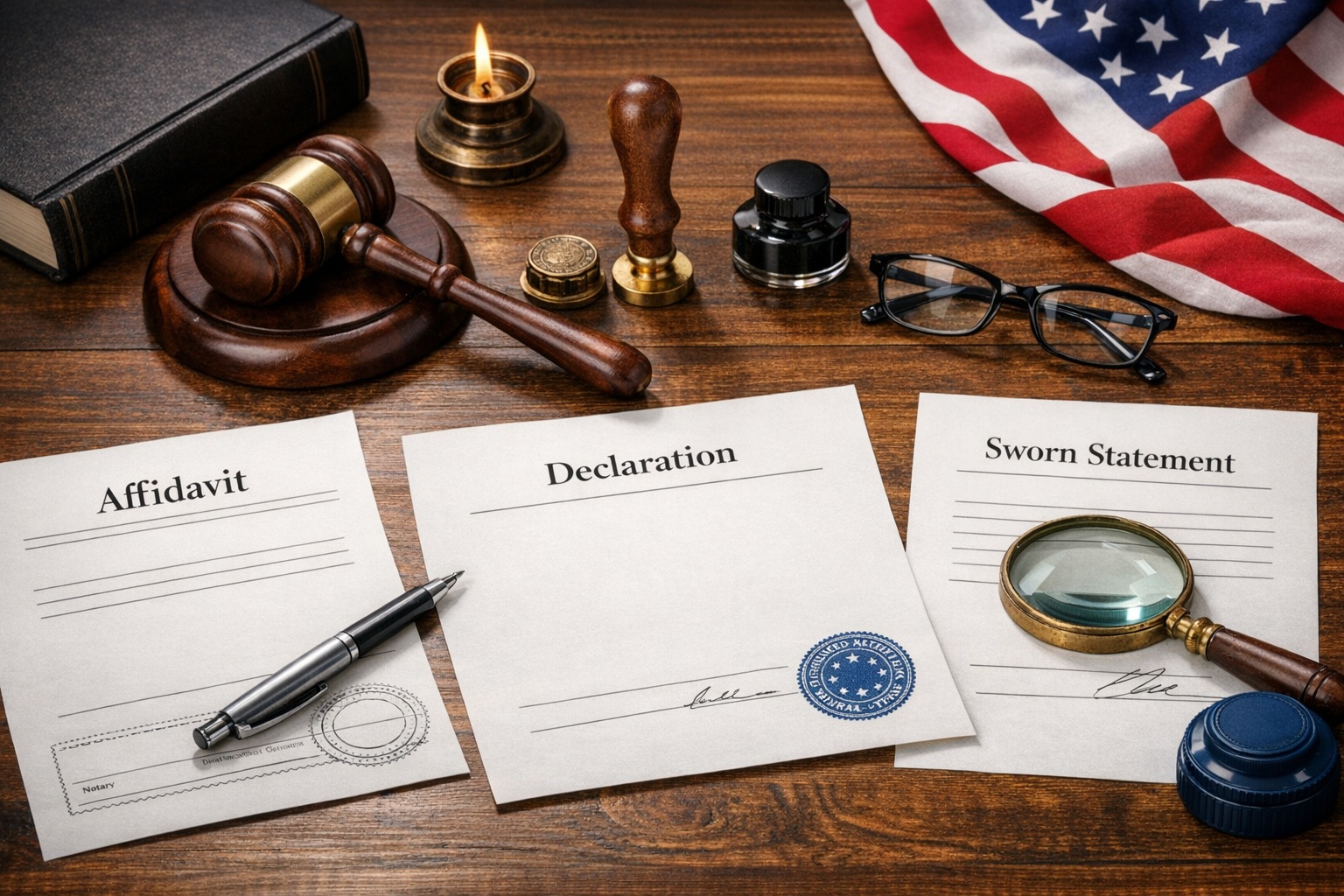
Affidavits vs Declarations vs Sworn Statements
Affidavits require you to appear before a notary public, take an oath, and sign while they watch. The notary administers the oath (“Do you swear this statement is true?”), witnesses your signature, and completes a jurat certificate with their official seal. This authentication process ensures courts and institutions accept your sworn statement as legally valid testimony.
Declarations work differently. You sign them “under penalty of perjury” without notarization. Federal courts accept declarations under 28 U.S.C. § 1746 with identical legal weight as affidavits. Florida statute § 92.525 permits the same approach for state matters.
Sworn statements is the umbrella term for both. When someone requests a “sworn statement,” ask which type they need. The answer determines your next steps.
When Notarization Adds Legal Validity
State courts typically require notarized affidavits because the notary’s verification adds an extra layer of authenticity. Real estate transactions, financial disclosures for divorce, immigration support documents (I-134, I-864), and witness statements heading to litigation all benefit from notarial authentication.
Federal courts and some state procedures accept declarations without notarization. Administrative filings often list declarations as acceptable alternatives. Call ahead and verify what format the receiving party wants.
The Jurat Certificate Requirement
Affidavits must have jurats, not acknowledgments. Understanding the difference between notary roles helps clarify why specific certificate types matter for different documents.
A jurat confirms: “Sworn to and subscribed before me on [date] by [name].” The “sworn to” language proves you took an oath before a notary.
An acknowledgment confirms: “Acknowledged before me on [date] by [name].” This verifies you signed but doesn’t include an oath.
The jurat’s oath component is what creates the affidavit’s legal validity in court proceedings.
The Notarization Process
- Notary verifies your identity by checking your photo ID against your face
- You’ll be asked to raise your right hand and swear the statements are truthful
- Sign the document in front of the notary, they must watch you do this
- Notary stamps the document with their official seal and signs it
- Your signature and oath create the legal sworn testimony courts require
Writing Affidavits That Work
- Give it a clear title so anyone reading knows exactly what it’s about
- Number each paragraph makes it easier when someone needs to reference a specific statement
- Write like you’re telling your story: “I saw…” not “The affiant observed…”
- Stick to what you actually know firsthand not what someone told you
- Describe what happened, not your opinion about who’s right or wrong
- Sign and date it in front of the notary, nowhere else
Preparing Documents Correctly
- Show up with your document unsigned signing beforehand defeats the purpose
- Bring current ID with a clear photo and your signature visible
- Expect to pay around $5-10 cash per signature
- Make sure there are no cross-outs, white-out marks, or corrections on the document
- If you made a mistake, print a fresh copy rather than trying to fix it
When Declarations Work as Alternatives
Declarations offer a simplified option when the law permits. Federal courts accept this format: “I declare under penalty of perjury that the foregoing is true and correct. Executed on [date].”
States with declaration statutes offer similar options. The legal consequences for false statements are identical whether you use an affidavit or declaration. Both carry perjury penalties.
Some attorneys prefer notarized affidavits because the visible formality of a notary’s seal and jurat adds weight in legal proceedings. The notary’s authentication provides an additional verification layer that some courts and institutions value.
| What Matters | Affidavit | Declaration |
| Notary authentication | Required | Not required |
| Oath administered | Yes | No |
| Certificate type | Jurat | None |
| Legal force | Full | Equal |
| Cost | $5-10 | $0 |
| Where accepted | Most state courts | Federal courts, some states |
Remote Notarization Technology
Video notarization lets you meet with a notary online through secure platforms. You show ID through your camera, take an oath, and sign electronically. The notary authenticates your signature remotely using identity verification technology.
Remote notarization costs $25-50 per signature. Check acceptance before booking. Federal courts generally allow remotely notarized documents. State rules vary based on their adoption of remote notarization statutes.
Why Proper Authentication Matters
According to court filing data from 2024, improperly notarized affidavits account for 22% of rejected legal filings in family court cases. Courts require specific notarial certificates because they ensure documents meet legal standards.
Financial affidavits need correct notarization for child support orders to proceed. Real estate affidavits require proper jurats for property transactions to close. Immigration affidavits must have the right certificates for applications to be processed.
Working with a qualified notary who understands these requirements helps ensure your documents are accepted the first time. Their expertise in proper authentication saves time and prevents procedural delays.
Frequently Asked Questions
Can I notarize an affidavit if I don’t have a driver’s license?
Your passport, state ID, or military ID works just fine. As long as it’s government-issued with your photo and signature, you’re good to go.
Do I need to bring my own notary form or does the notary provide it?
You write and bring your affidavit, the notary handles their part. They’ll add the official certificate, stamp it with their seal, and sign after you have signed.
Can I get an affidavit notarized the same day I need it?
Usually yes. Most notaries take walk-ins or can fit you in same-day. The whole thing takes about 5-10 minutes once you’re there with your unsigned document and ID.
Getting Documents Authenticated Correctly
Affidavits need jurats from qualified notaries. Declarations skip notarization when statutes allow. Understanding which document type you need and following proper procedures ensures your paperwork is accepted.
Need professional notarization services? Contact Notary Plus More at (561) 491-9550. We provide authentication for affidavits, jurats, and all notarization types with the expertise that ensures proper documentation. Our notary services help you avoid rejections and get your documents done right the first time.