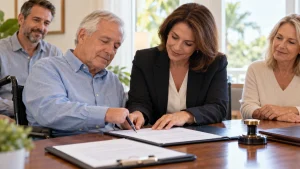

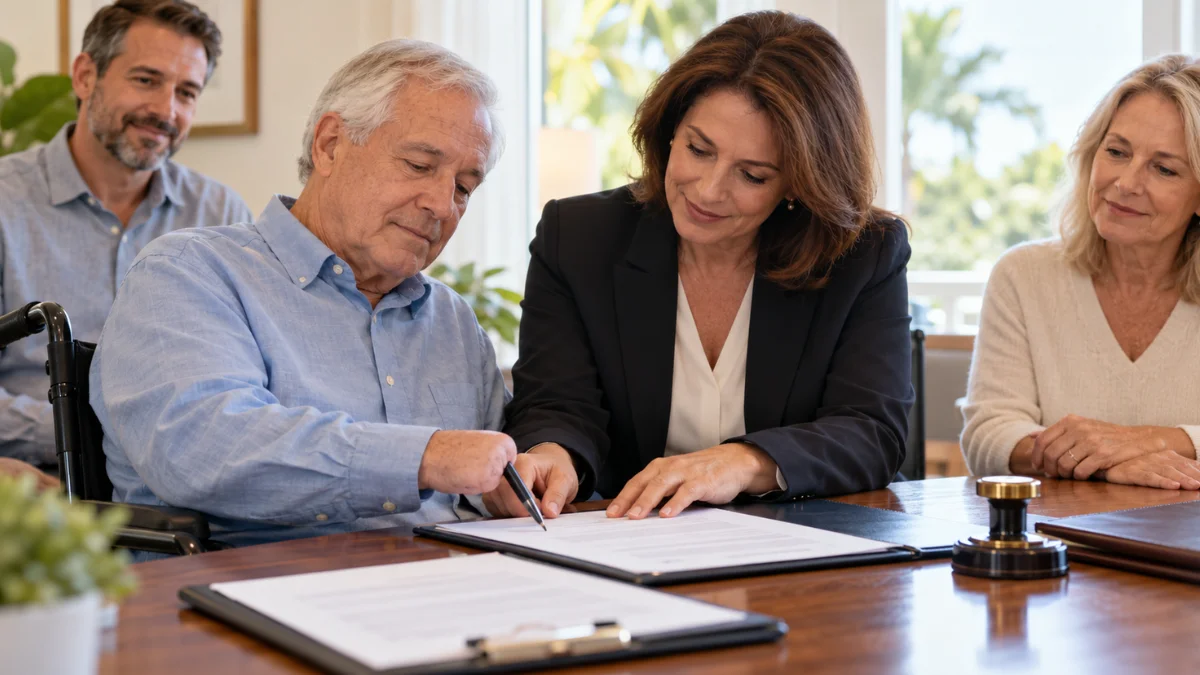
A Florida notary may sign a document on behalf of a person who is physically unable to sign, provided that person directs the notary to do so and two disinterested witnesses are present. Florida law also allows a signer who can make a mark, but not a full signature, to sign by mark before two disinterested witnesses. Both procedures are set out in section 117.05(14) of the Florida Statutes. Each carries specific wording and recordkeeping requirements that the notary must follow for the notarization to be valid.
These provisions are particularly relevant for people recovering from a stroke, living with advanced arthritis or Parkinson’s disease, recovering from surgery or managing a temporary injury to the hand or arm. They allow important documents to be executed without requiring a signature the person cannot physically produce.
Florida Notary Options for Those Unable to Sign
The appropriate procedure depends on what the signer is able to do. A person who can hold a pen and make a deliberate mark, such as an “X,” may sign by mark. A person who cannot make any mark at all may direct the notary to sign on their behalf.
In both situations, the signer must still be the person who decides to execute the document. The notary acts as an impartial official throughout and does not decide whether the document should be signed or what it should contain.
How Does Signing by Mark Work in Florida?
Section 117.05(14)(b) permits a notary to notarize the signature of a person who signs with a mark when three conditions are met. The signing must be witnessed by two disinterested persons. The notary prints the person’s first name at the beginning of the designated signature line and the person’s last name at the end of it. The notary then prints the words “his (or her) mark” below the mark.
The notarial certificate must also reflect the circumstances. The statutory wording for both oaths and acknowledgments states that the person signed with a mark in the presence of the witnesses identified on the certificate. This creates a clear record showing that the mark was made deliberately and observed by individuals with no stake in the document.
Can a Florida Notary Sign on Behalf of Someone With a Disability?
Section 117.05(14)(d) applies when a person with a disability cannot sign or make a mark. In that case, the notary may sign the person’s name only if the person directs the notary to sign in his or her presence by verbal, written or other means. The document signing must again be witnessed by two disinterested persons.
Beneath the signature, the notary writes the notation “Signature affixed by notary, pursuant to s. 117.05(14), Florida Statutes,” followed by a description of the circumstances and the means by which the notary was directed to sign. A signer might direct the notary verbally, through a written instruction, by a nod in response to a clear question or through an assistive communication device.
The statute adds a recordkeeping duty. The notary must maintain proof of the direction and authorization to sign on behalf of the person with a disability and keep that proof for 10 years from the date of the notarial act. The certificate itself identifies the person at whose direction the notary signed, the means of direction and the witnesses present.
Who Qualifies as a Disinterested Witness in Florida?
A disinterested witness is someone who has no financial or personal interest in the document being signed. A beneficiary named in a will, an agent appointed under a power of attorney or a buyer in a property transfer would not qualify. Close relatives may also be unsuitable where they stand to benefit from the document, even when the law does not name them specifically.
The same principle of impartiality governs the notary. Florida law prohibits a notary from notarizing for a spouse, son, daughter, mother or father. The restrictions on notarizing for family members apply with equal force when a relative has a disability. Arranging neutral witnesses in advance, such as facility staff who are permitted to serve or individuals supplied by the notary, prevents delays on the day of signing.
Choose Right Notary Solution for Your Needs
Identification and Mental Capacity Requirements for Notarization
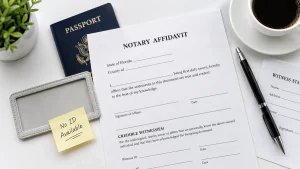
These procedures address the physical act of signing. They do not relax the requirement that the notary confirm who the signer is. The notary must still identify the person through personal knowledge or satisfactory evidence of identity, usually a current government-issued photo ID. Where identification is unavailable, Florida permits identification through credible witnesses under specific conditions, as explained in the rules on getting notarized without id.
The notary must also be satisfied that the signer understands the document and is acting willingly. A notary may decline to proceed if the person appears confused, unable to communicate a clear decision or under pressure from others present. Questions about legal capacity to execute a will or power of attorney fall outside the notary’s role and should be directed to an attorney before the appointment.
Florida Documents That Have Additional Signing Requirements
Some Florida documents carry separate statutory provisions on signatures made by another person. A will may be signed by another person at the testator’s direction and in the testator’s presence under the Florida Probate Code, with its own witnessing formalities. Health care surrogate designations and living wills likewise permit another person to sign at the principal’s direction. Because these rules differ from the notarial provisions in Chapter 117, the person preparing the document should confirm which requirements apply.
Powers of attorney are a frequent example. A durable power of attorney in Florida must be signed by the principal and two witnesses and acknowledged before a notary, so an attorney will often coordinate the notarial procedure with the witnessing requirements of the power of attorney itself.
Final Thoughts
Preparation helps the appointment proceed smoothly. Before scheduling, the family or representative should confirm the signer’s identification, decide whether a signature by mark or a notary signature will be used, arrange two disinterested witnesses and make sure the document is complete but unsigned. Advising the notary of the circumstances in advance allows the correct certificate wording to be prepared.
Many signers in this situation cannot travel easily. A mobile notary appointment brings the notary to a home, hospital, rehabilitation center or assisted living facility, where the signer can complete the process in familiar surroundings. The certificate wording in section 117.05(14) also contemplates online notarization, although witness arrangements and facility policies may make an in-person appointment more practical.